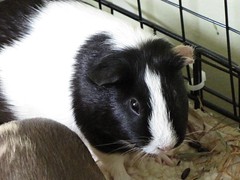
After more procrastination than I care to think about, I present to you the fourth installment of Cutting Back. This post is mostly about the joy and wonders of fleece bedding, but I also have some tips for those of you who prefer not to handle poop on a daily basis.
Fleece Bedding
I'm not sure who ever discovered that Polar Fleece is perfect for guinea pig bedding, but I want to publicly congratulate him or her. Many of us--be we environmentalists, penny pinchers or just avid pigpen-interior decorators--are eternally grateful. Fleece bedding reduces our impact on the environment because it is made from recycled plastic bottles and we get years of use out of it--keeping tons of single-use disposable bedding off of transport trucks and out of landfills. It is an initial investment [depending on your cage size it could be anywhere from $20 and up] but it will pay for itself within a month or two.
Acquiring polar fleece
You can get polar fleece from a number of places.
Most people get it new from a fabric supply store, They usually have it for $8-$13 per yard [36"x60"]. For this post we will assume the fleece was $11 per yard. Once you've gotten a sifficient amount of polar fleece, it is important to wash it 3-4 times on a "heavy duty" cycle in your washing machine with detergent, but NO fabric softener. Most fabric softeners hinder the fleece's ability to wick moisture from the surface. And they are usually unnecessary. You do not need to hem your fleece, it will not fray.
I prefer to get mine from thrift stores. A normally-sized fleece throw will fit a 2x3 or a 2x3.5 C&C cage quite nicely. My boys Milo and Winston share a 2x3 currently, and this is what I use for them. Fleece throws at my local Salvation Army usually cost $2.49. They also have the added advantage of already being somewhat worn-out, which is important if you want the fleece to wick away your pigs' urine and keep them nice and dry. This way you only have to wash them once as opposed to 3-4 times.
A very important note about acquiring fleece secondhand: PLEASE be sure to wash ANY fleece, towels, or other fabric products you get from a thrift shop before giving it to your cavies. My entire herd is recovering from a lice infestation because I recently put them on wool blankets that had lice living in them unknowingly, without carefully washing and line-drying them as I usually do beforehand.
Just as you would quarantine a new guinea pig before putting it with your existing herd, Quarantine anything you get secondhand before exposing it to your cavies. I usually wash all my pigs' bedding with Arm&Hammer powder detergent, a squick of non-chlorine bleach and very very hot water. I then tumble dry them and hang them on the clothesline to bleach in the sun. Skipping this important process just once landed my poor cavies in a world of yuck and I do not wish the same on your dear beloved pets.
What goes underneath?
In order for this method to work, you absolutely must have something underneath the fleece. Otherwise, the results will be just as disgusting for you to clean as it is for your guinea pigs to live in.
Many people, myself included, prefer to put towels underneath the fleece. I acquire my towels from a thrift store as well, using the same sterilizing method as described above. I usually put 3
layers of towel under the fleece; a normally-sized towel folded in thirds fits almost perfectly in a 1x2 grid space which makes it easy to calculate how many you need. Towels at my local thrift store usually go for $1.99 apiece.
The average price I found for a new towel [I compared Bed, Bath & Beyond, Target, Wal*Mart, K-Mart and Big Lots] was about $3.50 per towel.
You can also use Mattress Pads, at around $6.00 per pad. I wouldn't use less than two layers. One Mattress Pad fits perfectly into a 2x4 C&C cage.
If you so choose, you can use Newsprint under your fleece. Though it is not ideal, if you are a subscriber or if you get it free from your workplace, it is the cheapest option. For this post we will consider it $free.
Some people use Puppy Training Pads, but not only do these create unnecessary waste that will never disappear, but if your cavy ingests a significant amount of this soft plastic material, it can cause intestinal blockage and in severe cases, death. I don't recommend using Puppy Pads under your fleece because of this and also, they are not very absorbent.
Expense analysis:
For this post we will assume you have a 2x4 C&C cage, since this is the most common size. I would be happy to fudge with the number if you'd like to know what the cost would be for your particular cage, please just comment below. We are also assuming that you have two sets of fleece and towels in this post.
+Fleece and towels acquired used: $21.00
+Fleece and towels acquired new: $50.00
+Fleece [new] and newsprint: $22.00
+Fleece [new] and mattress pads: $45.00
Compared to the old way(s)...
Again, assuming you have a 2x4 C&C and change the bedding weekly.
+Yesterday's News: $315.00 per year
+Equine Pine: $126.00 per year
+Woodstove Pellets: $84.00 per year
+Aspen Shavings: $273.00 per year
+Carefresh: $613.00 per year
Kitchen Areas
Kitchen Areas are a wonderful addition to the fleece-bedded cage. For those of you who don't use a hay rack, they're a great place for your pigs to play in the hay without making a big mess all over your fleece. They're called Kitchen Areas because that's
where all the food is! The hay, pellets, and salads are served there.. why? Because guinea pigs are furry poop tubes. When something goes in one end, something is pushed out the back end. Rabbits are the same way, but they can jump higher than cavies can.
My kitchen area for my girls' main cage--a 2x9 C&C--is 28"x21", or 2x1.5 grids. It is simply a box I made from leftover coroplast. When I want to clean it I remove the entire thing, dump its contents in my compost heap or garden or around the lilac bush, scrub it down with vinegar and water and fill it with disposable bedding.
Many people use their old pet store cages or lofts as kitchen areas, which work quite well. Beware that if you use either of these options, it is not considered part of the overall square footage of the cage, which is why when it comes to
cavy cages, bigger is always better.
Here is a short assessment of disposable beddings that can be used alone or in combination with one another for the kitchen area or the entire cage..
Disposable Beddings
+ Mulch hay: $Free-$2/bale
Mulch hay makes an especially great top layer for your cage or kitchen. It is simply old, leftover hay that is completely brown and has no nutritional content. If your pigs eat it, it will not harm them. Make absolutely sure that the mulch hay you are getting is not at all moldy. If you find a moldy part of your hay bale, remove it and much of the hay surrounding it and do no give it to your guinea pigs.
+ Pelleted Beddings: $4-20/40lb. bag
Pelleted beddings make a great bottom layer for your cage or kitchen. They are not as hard on a guinea pig's foot as they appear. Pelleted beddings are very absorbent and expand when they come into contact with liquid. They do not stick to the bottom of your pigs' litterbox, which is a problem with most other beddings.
[In order from least to most expensive:]
Wood Stove Pellets, Equine Pine, Feline Pine, and Yesterday's News are some of the most popularly-used pelleted beddings. Make sure that if you use wood stove pellets, you're using a pellet without any propellent.
+ Shavings: $10-$15/4 cu. ft
The only shavings that should be used for your guinea pigs are Aspen or
kiln-dried pine. These are free of the aromatic oils that can cause infections. Shavings are soft on the feet but not terribly absorbent. They are best used as a top layer paired with a pelleted bedding.
+ CareFresh: $18-$24/60L
CareFresh is some of the greatest bedding out there. It is lightweight and soft yet very absorbent. It's quick to decompose and is the perfect addition to vermicompost. It is quite expensive, but when I feel like a splurge, I go straight for the CareFresh.